In 2026, the call of the wild is louder than ever. As the global wildlife tourism market surges toward a projected $17.3 billion this year, more travelers are seeking “meaningful” connections with nature. However, with this growth comes a sophisticated shadow: greenwashing.
An ethical safari is defined by three non-negotiable pillars: the prioritization of animal welfare over human entertainment, the direct financial empowerment of local communities, and the measurable conservation of biodiversity. Unfortunately, many modern tours use “eco-vibe” aesthetics to mask practices that actually harm the ecosystems they claim to protect.
This guide will help you look past the bamboo straws and “eco-resort” labels to identify genuine sustainability in the 2026 safari landscape.
🌱 Table of Contents
The Anatomy of Greenwashing in 2026
Greenwashing in tourism is no longer just about “save the towels” signs. In 2026, it has evolved into “eco-silence” (hiding negative data) or “tokenism” (highlighting one solar panel while ignoring a massive carbon footprint from private jet transfers).
Why It Happens
According to recent industry reports, over 80% of global travelers now believe sustainable travel is important. To capture this lucrative market, some operators “paint” a green veneer over standard commercial operations. They explain what they do (e.g., “We support schools”) without explaining how (e.g., what percentage of your $1,000/night stay actually reaches that school?).
The Impact
When you book a greenwashed tour, the consequences are tangible:
- Behavioral Stress: Constant vehicle proximity disrupts hunting and mating patterns of predators like cheetahs.
- Economic Leakage: Often, less than 10% of safari revenue stays in the local community, perpetuating cycles of poverty that drive poaching.
- Habitat Fragmentation: “Eco-lodges” built on migratory corridors can permanently block vital wildlife paths.
Red Flags: Spotting the “Fake” Eco-Tour
Identifying an unethical operator requires looking for what is missing as much as what is present.
1. Guaranteed Sightings and “Baiting”
Wildlife is unpredictable. Any operator offering a “100% guarantee” to see a leopard or a rhino is likely using unethical tactics. This often involves “provisioning” (feeding animals) or using trackers who harass animals into view.
2. Physical Interaction (The “Selfie” Trap)
The Global Federation of Animal Sanctuaries (GFAS) is clear: a reputable sanctuary never allows guests to touch, pose with, or wash wild animals.
- The 2026 Reality: Even “ethical” elephant washes are now flagged by experts as traumatizing, as the training required to make an elephant “safe” for human touch involves severe physical coercion.
3. Vague Conservation Claims
Beware of phrases like “A portion of proceeds goes to conservation.” In 2026, transparency is the gold standard. Ethical operators will name their partners (e.g., African Wildlife Foundation, Big Life Foundation) and provide annual impact reports.
The “Big Three” of Ethical Wildlife Tourism
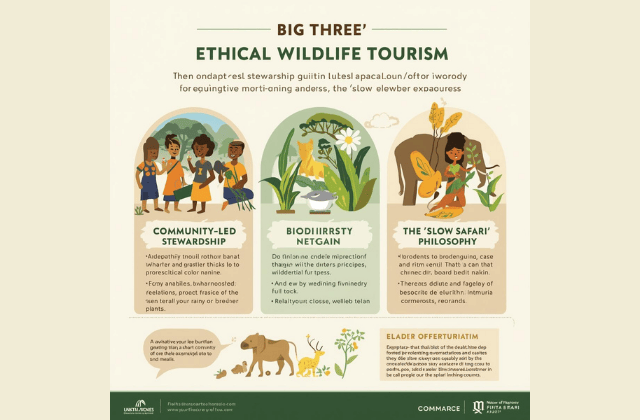
To ensure your 2026 journey supports the planet, verify these three pillars:
I. Community-Led Stewardship
True sustainability is intersectional. If the lodge is owned by a foreign corporation and the local Maasai or Samburu people are only employed as “performers” or low-level staff, it isn’t an ethical safari.
- Expert Insight: Look for Community Conservancies. These are areas where land is leased from local owners, ensuring they receive direct rent and management power.
II. Biodiversity Net Gain
Does the lodge simply “exist” in nature, or does it improve it? Ethical operators in 2026 are moving toward Rewilding.
“The biodiversity crisis is inseparable from the climate crisis. Tourism must move beyond ‘doing no harm’ to actively restoring degraded lands.” — IUCN World Commission on Protected Areas.
III. The “Slow Safari” Philosophy
Over-tourism is a form of environmental degradation. Ethical operators now promote “Slow Safaris”—spending five nights in one location rather than “hopping” between five parks in a week. This reduces carbon emissions and provides a deeper, less intrusive observation of animal behavior.
Case Study: The Rise of Wildlife Heritage Areas
A major trend for 2026 is the expansion of Wildlife Heritage Areas (WHAs). This initiative, a collaboration between World Animal Protection and the World Cetacean Alliance, identifies destinations that meet the highest standards of animal welfare and community involvement.
For example, Algoa Bay in South Africa was recognized as a WHA. Instead of captive dolphin shows, the community focuses on responsible boat-based viewing that respects the animals’ natural environment. This shift has proven that “wild” tourism is more profitable long-term than “captive” tourism.
The 2026 Ethical Safari Checklist
Before you hit “Book,” run your operator through this rigorous 5-point check:
- [ ] Accreditation: Are they certified by the Global Sustainable Tourism Council (GSTC) or a regional body like Ecotourism Kenya or Fair Trade Tourism (FTT)?
- [ ] The “No-Touch” Rule: Does their social media feature guests touching animals? (If yes, abort).
- [ ] Vehicle Policy: Do they limit the number of vehicles at a sighting? (The ethical standard is usually 3–4 maximum).
- [ ] Financial Transparency: Can they tell you exactly how much of your fee goes to the local community?
- [ ] Waste & Water: Do they have a closed-loop system? In 2026, “recycling” isn’t enough; look for on-site greywater treatment and zero-single-use-plastic policies.
The Future Outlook: AI and Transparency
By late 2026, the EU’s Empowering Consumers for the Green Transition (EmpCo) Directive will strictly ban unsubstantiated “eco-friendly” claims and carbon-neutrality promises reliant solely on offsets.
Technologically, we are seeing the rise of Blockchain-tracked tourism levies, allowing travelers to see exactly where their “conservation fee” is spent in real-time. Additionally, AI-driven platforms are beginning to aggregate real-time reviews from researchers and NGOs to “rank” lodges based on actual ecological impact rather than just guest comfort.
Conclusion: Awareness is Your Best Gear
An ethical safari is more than a vacation; it is a contribution to a global effort to save our most vulnerable species. As we move through 2026, the responsibility shifts to us, the travelers. By rejecting the “Disney-fication” of the wild and demanding radical transparency, we can ensure that the lions we watch today will still have a home tomorrow.
Don’t just travel. Travel with a conscience.
Also Read:- Top 10 Savanna Animals : Hidden Gems of Africa’s Grasslands
Frequently Asked Questions (FAQ)
1. Is “Eco-tourism” the same as an “Ethical Safari”?
Not necessarily. “Eco-tourism” is a broad term that can be used loosely for marketing purposes. An ethical safari specifically prioritizes animal welfare, fair community wages, and conservation practices backed by rigorous science.
2. Why should I avoid “walking with lions” or “elephant washing”?
These activities require animals to be conditioned or “broken” through dominant training. In a truly ethical wildlife setting, wild animals should never be habituated to human touch for entertainment.
3. How can I verify a lodge’s ethical claims?
Look for independent, third-party audits. Check whether the lodge appears on the IUCN Green List or is a member of reputable organizations like The Long Run, which evaluates operators using the “4Cs”: Conservation, Community, Culture, and Commerce.
4. Are carbon offsets effective for safaris?
Carbon offsets should be a secondary measure. Ethical operators focus first on reducing emissions through renewable energy, electric safari vehicles, and efficient logistics. Relying only on offsets without reduction efforts is often a sign of greenwashing.