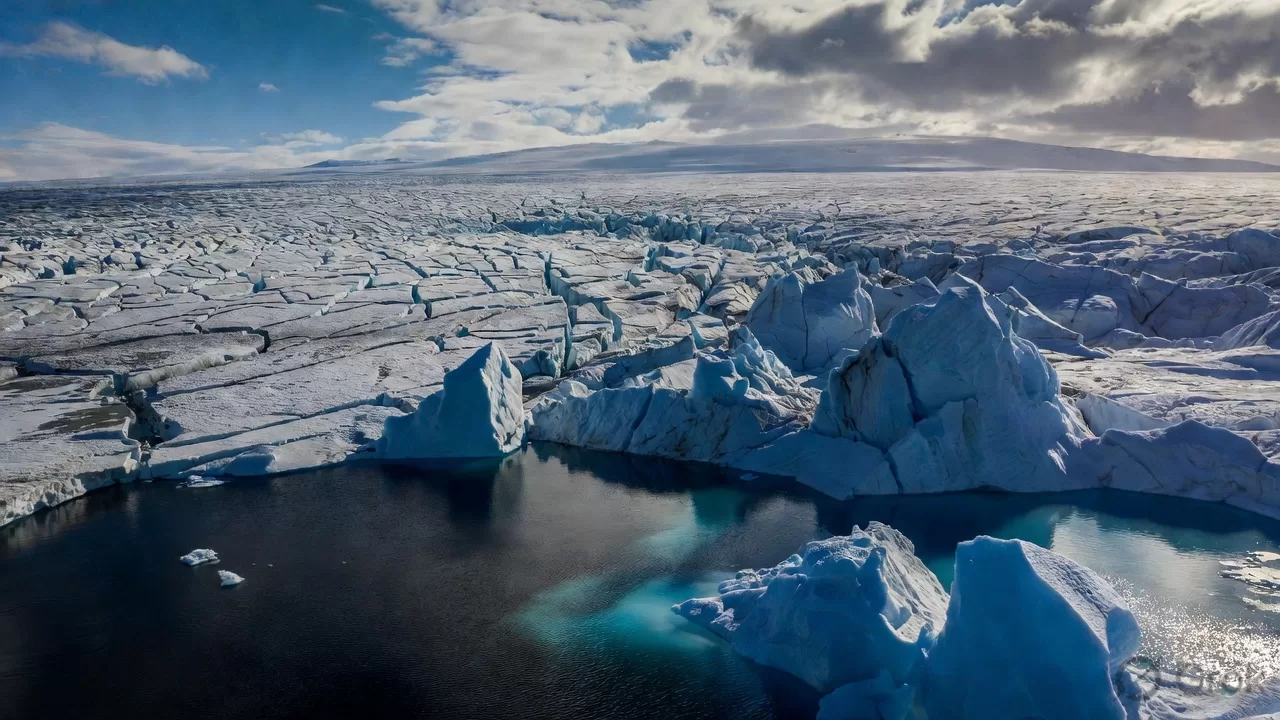
Antarctica has long been considered one of Earth’s most stable frozen regions. That assumption is now shattering. Alarming new research published in Nature Communications reveals that Antarctic ice shelves are being eaten away from beneath at a rate climate models never anticipated — and the implications for global sea levels are profound.
The Hidden Threat Beneath the Ice
Most people picture Antarctic ice melting from above, under the heat of the sun and warming air. But the real danger, scientists now know, is happening invisibly, deep underwater. Warm ocean water is creeping beneath massive floating ice shelves — the giant extensions of glaciers that stretch out over the ocean like natural dams — and melting them from below.
Researchers from the iC3 Polar Research Hub in Norway made a critical discovery studying the Fimbulisen Ice Shelf in East Antarctica. They found that long, channel-like grooves carved into the underside of ice shelves act as traps for warm seawater. Instead of the warm water passing through and moving on, these channels create small circulation cells that hold the warmth in place directly against the ice — dramatically accelerating local melting.
The study, published in Nature Communications in 2026, warns that current climate models may be missing this process entirely, meaning future sea level rise projections could be significantly underestimated.
Why Ice Shelves Are Earth’s Frozen Guardrails
To understand why this matters, it helps to understand what ice shelves do. These floating platforms of ice — some the size of small countries — act as buttresses. They slow the flow of the massive land-based glaciers behind them. Without ice shelves acting as brakes, glaciers accelerate toward the sea.
When ice shelves thin and weaken from below, they lose their ability to hold back the glaciers behind them. More land ice slides into the ocean. And when ice that was on land enters the sea, global sea levels rise. The West Antarctic Ice Sheet alone holds enough ice to raise global sea levels by over 5 metres if it collapsed entirely.
The IPCC has previously identified weakening polar ice shelves as a major and poorly understood risk factor — a gap that this new research makes significantly more urgent.
East Antarctica: The Sleeping Giant Wakes
What makes this discovery especially alarming is its location. East Antarctica was previously considered far more stable and resistant to change than its western counterpart. Scientists focused most of their concern on West Antarctica and the Amundsen Sea region, where glacier retreat has been ongoing for decades.
The Fimbulisen findings suggest that East Antarctica — which contains even more ice — may be far more sensitive to ocean warming than scientists realized. Changes already observed in West Antarctica are now being projected to affect East Antarctic ice shelves as the ocean continues to warm.
Researchers note this dynamic has already been observed elsewhere in Antarctica, signalling that this is not an isolated phenomenon but a systemic risk across the continent’s coastline.
The Global Stakes: Coastal Cities at Risk
A faster-than-expected rise in sea levels is not an abstract scientific concern. Hundreds of millions of people live in low-lying coastal areas. Major cities including Mumbai, Bangkok, Miami, Jakarta, and Shanghai face existential flooding threats if sea level rise accelerates beyond current projections.
The ocean is already warming at approximately triple the historical rate in some Antarctic regions. Research suggests that even under the Paris Agreement’s most ambitious 1.5°C target, committed ocean warming may drive widespread ice shelf melting that cannot now be reversed.
What Needs to Happen
Scientists call for an urgent update to global climate models to incorporate the channelized melting process discovered at Fimbulisen. Current sea level projections used by governments and urban planners may be based on incomplete data.
Beyond modeling, the research reinforces the case for rapid decarbonization. Every degree of ocean warming averted reduces the pace at which warm water can penetrate and trap beneath ice shelves. Investing now in coastal adaptation infrastructure — seawalls, mangrove restoration, managed retreats from flood-prone zones — is no longer optional for at-risk nations.
Key Takeaways
Antarctica is melting from below in ways climate science did not fully anticipate, driven by warm ocean water trapped in hidden ice shelf channels. The implications for global sea level rise are severe, and models used by policymakers urgently need updating. The world’s coastlines depend on scientists and governments taking this new evidence seriously — now.