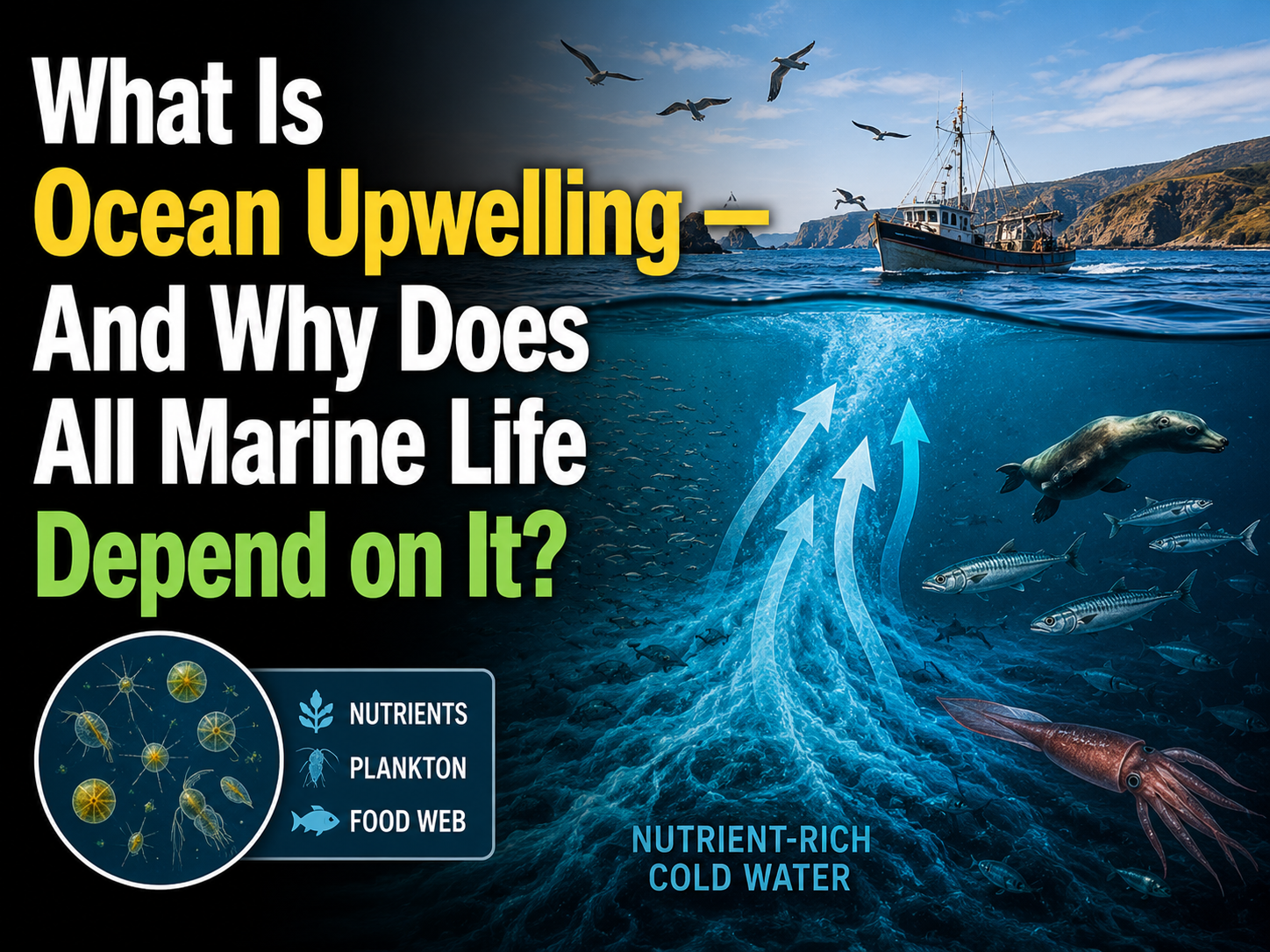
The ocean looks blue and largely empty from the surface, but beneath it, invisible currents are doing some of the most important biological work on Earth. One of the most powerful is a process called ocean upwelling — and when it works, it feeds billions of people. When it fails, entire ecosystems can collapse within a single season. Scientists watching the Gulf of Panama in 2025 saw exactly that happen for the first time in 40 years.
What Is Ocean Upwelling?
Ocean upwelling is the process by which deep, cold, nutrient-rich water rises to the ocean’s surface to replace warmer water that has been pushed away by wind or ocean currents.
Here’s the simple version: wind blows across the ocean surface, pushing the top layer of water in a particular direction. When that surface water moves away from a coastline or diverges in the open ocean, something has to fill the gap. Cold water from depths of 200 to 1,000 metres rises to take its place. That cold water has been sitting in the dark for months or years, accumulating nutrients from the decomposition of organic matter that sinks from the surface — phosphates, nitrates, and silicates that surface water has long since consumed.
When this nutrient-rich water reaches the sunlit upper ocean, the results are explosive: phytoplankton bloom in massive numbers, visible from satellites as vast green and turquoise swirls across the ocean surface. That bloom is the foundation of some of the world’s most productive marine ecosystems.
The Two Main Types of Upwelling
Coastal upwelling occurs where wind blows parallel to a coastline, pushing surface water offshore through a process called Ekman transport. As the warm surface layer moves away, cold, deep water rises to replace it along the coast. This is what happens along the coasts of Peru, Chile, California, Namibia, and Morocco — some of the world’s most productive fisheries zones.
Open ocean upwelling happens in the equatorial Pacific, where trade winds blow warm water westward. As warm surface water piles up near Asia and Australia, cold water rises along the equator in the central and eastern Pacific to fill in behind it. This equatorial upwelling system plays a central role in global ocean circulation and the ENSO climate cycle.
A third, less common form — polar upwelling — occurs in the Southern Ocean around Antarctica, where wind patterns drive significant nutrient cycling that supports the krill-based food web underpinning Antarctic marine life.
Why Does Upwelling Make Oceans So Productive?
The open ocean is, for most of its area, a biological desert. Warm surface water is low in nutrients. Without nutrients, phytoplankton cannot grow. Without phytoplankton, nothing can eat. The result: vast expanses of the subtropical ocean that are strikingly blue and strikingly empty.
Upwelling zones are the exact opposite. They cover less than 1% of the world’s ocean surface area, yet they support roughly 20% of global wild fish catches. The reason is nutrient delivery:
- Phytoplankton bloom in the nutrient-rich surface water, photosynthesizing and forming the base of the food chain
- Zooplankton feed on the phytoplankton, becoming the food supply for small fish
- Sardines, anchovies, and herring thrive in enormous numbers, feeding on zooplankton
- Tuna, swordfish, sea lions, and sharks follow the smaller fish
- Seabirds nest in massive colonies near productive upwelling coasts, relying on the fish supply
- Commercial fisheries harvest the fish, supporting livelihoods for millions of people
The Humboldt Current system off Peru and Chile — one of Earth’s most powerful coastal upwelling zones — produces more fish per square kilometre than almost any other ocean region on the planet, despite being surrounded by some of the driest desert land on Earth.
Famous Upwelling Zones Around the World
| Region | System | Known For |
|---|---|---|
| Peru & Chile | Humboldt Current | World’s largest anchovy fishery |
| California | California Current | Rich marine biodiversity, whale feeding |
| Namibia & South Africa | Benguela Current | Sardine and anchovy fisheries |
| Morocco & Mauritania | Canary Current | Major EU fishing grounds |
| Gulf of Panama | Panama Upwelling | Tropical productivity, tuna, reef cooling |
| Arabian Sea | SW Monsoon Upwelling | Supports fisheries across Indian Ocean rim |
How Climate Change Is Threatening Upwelling Systems
Upwelling depends on specific, finely tuned conditions — particularly the strength and direction of prevailing winds. Climate change is altering those conditions in ways scientists are only beginning to understand.
Several documented and projected threats include:
Ocean stratification: As surface waters warm due to climate change, they become less dense relative to the cold water below. This strengthens the barrier between the warm surface layer and the cold deep ocean — making it harder for upwelling to push cold water all the way to the surface, even when winds are strong.
Trade wind changes: The trade winds that drive equatorial and some coastal upwelling are linked to global atmospheric circulation patterns, which are being reorganised by warming. The Gulf of Panama’s 2025 upwelling failure was driven by unusually weak trade winds — a pattern that may become more common.
El Niño intensification: During El Niño events, warm water spreads across the eastern Pacific, suppressing upwelling along the South American coast. The 2026 Super El Niño is expected to temporarily devastate fisheries across the Humboldt Current system, as every previous strong El Niño has done.
Deoxygenation: The deep water that rises in upwelling carries not just nutrients but dissolved oxygen. As climate change warms and deoxygenates the ocean interior, upwelled water may deliver less oxygen to surface ecosystems — compounding the stress on marine life.
What Happens When Upwelling Fails?
The 2025 Gulf of Panama event offers a real-world answer. When the upwelling didn’t occur:
- Chlorophyll concentrations dropped near zero — the bloom never came
- Fish that depend on the seasonal productivity pulse had no food source
- Coastal fishing communities faced dramatically reduced catches
- Coral reefs remained in warmer water through the season, increasing bleaching risk
Scientists from the Smithsonian Tropical Research Institute noted that one failed year doesn’t collapse a fishery outright — but it removes the nutritional pulse that entire populations of fish, seabirds, and marine mammals depend on annually. Multiple consecutive failures would be catastrophic.
Key Takeaways
Ocean upwelling may be invisible to most people, but it is one of the mechanisms that makes life on Earth — including human civilization — possible. It feeds coastal nations, supports global fisheries, and cycles nutrients through the ocean in ways that sustain biodiversity from the surface to the deep sea. As climate change rewires the winds and warms the waters that make upwelling possible, understanding what ocean upwelling is and why it matters has never been more urgent.
Leave a Reply