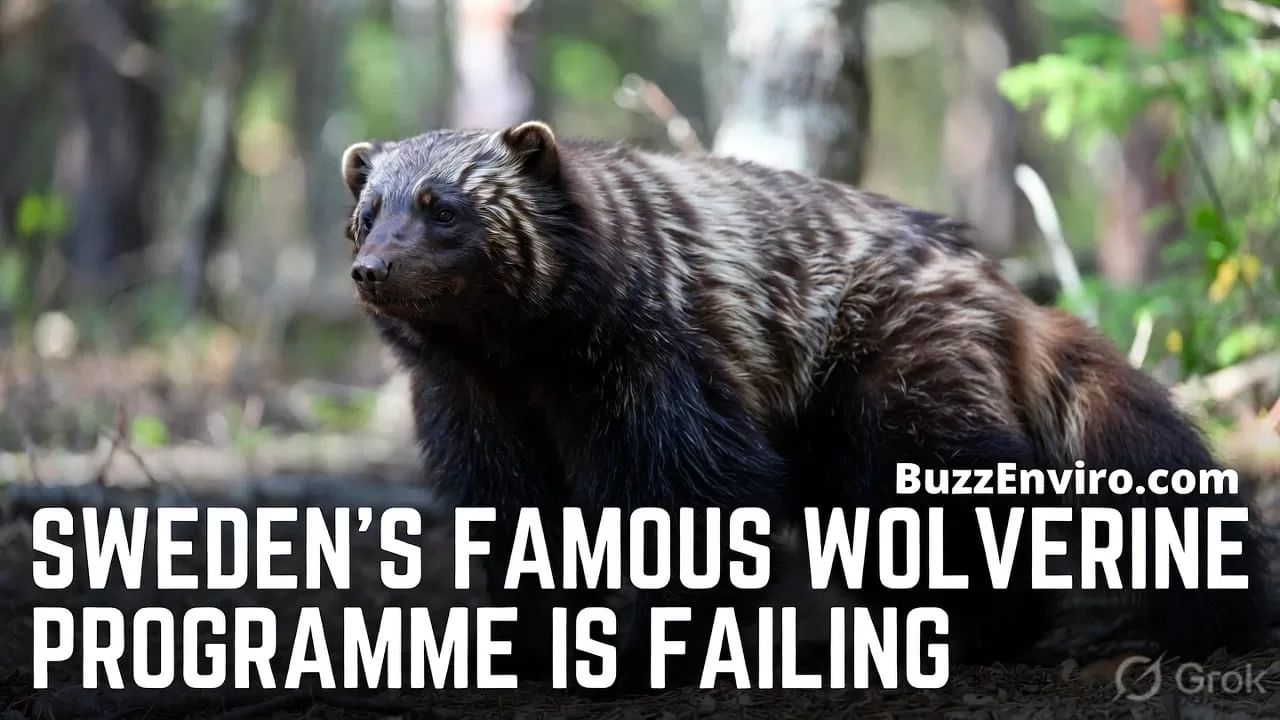
In 2015, Sweden’s wolverine programme was celebrated around the world. A decade later, it is unravelling — and the reasons should alarm every conservationist.
A Programme That Was Once a Global Model
In the early 2000s, Sweden faced a familiar challenge: how do you protect a recovering predator species — the wolverine — while also protecting the livelihoods of the communities that share land with it?
The wolverine (Gulo gulo) is a powerful, solitary carnivore of Arctic and sub-Arctic environments. In Sweden, wolverines prey on reindeer — the lifeblood of the Indigenous Sámi communities of Norrbotten, Sweden’s northernmost county, who have practiced reindeer herding for centuries.
Sweden’s answer was innovative. In 1996, the country launched a Conservation Performance Payment (CPP) scheme— the oldest of its kind in the world. Instead of simply penalising wolverines or compensating farmers after losses, the scheme paid Sámi communities directly for the presence of wolverines on their land, specifically for documented wolverine reproductions.
The logic was elegant: turn wolverines from a liability into an asset. If wolverines made money for reindeer herders through conservation payments, herders had a financial incentive to tolerate and protect them.
It worked. In 2015, a study revealed that the scheme had successfully boosted wolverine populations. It was celebrated internationally as a breakthrough model for human-predator coexistence. Conservation organisations worldwide pointed to Sweden as proof that payment schemes could align economic self-interest with wildlife protection.
What Happened Next — And What a New Study Found
Fast forward to 2026. A new study published in the journal Conservation Letters, led by Dr Hanna L. Pettersson at the University of York in collaboration with the Swedish Agricultural University, has revealed the disturbing trajectory of this once-praised programme.
After analysing 30 years of ecological monitoring data combined with community interviews in Norrbotten, the research team found a scheme in serious trouble.
The key findings:
- Documented wolverine numbers have fallen significantly in their northern strongholds — the very areas the CPP was designed to protect
- In the early 2000s, Norrbotten accounted for two-thirds of all documented wolverine reproductions nationwide; that proportion has declined sharply
- Government funding has been frozen for approximately 20 years, meaning payments have not kept pace with rising costs of coexistence
- Community trust among Sámi reindeer herders has eroded substantially
Why the Funding Freeze Was So Damaging
The CPP scheme’s original payment amounts made sense in the context of the late 1990s. But over two decades, the costs borne by Sámi communities — costs of reindeer losses, of monitoring, of participating in the scheme’s documentation requirements — increased significantly with inflation and changing conditions.
The government’s payments, meanwhile, stayed frozen. The scheme that was once financially attractive became financially burdensome. The burden of wildlife recovery was shifted onto local, often marginalised communities who were already straining under the cumulative impacts of mining, forestry, and climate change in their territory.
At the same time, strict government documentation rules required for payments to be approved meant that many clear wolverine sightings were disqualified on technicalities. Climate change added another layer of difficulty: altered Arctic snow conditions made wolverine tracks harder to find, meaning the actual wolverine population may be larger than officially documented figures suggest — yet those unofficial sightings did not qualify for compensation.
The Trust Collapse
Conservation programmes live and die on community relationships. When the communities bearing the costs of coexistence begin to feel the system is unfair, unresponsive, or simply not worth the trouble, trust evaporates — and with it, the collaboration that makes the programme work.
Sámi herders interviewed as part of the research described a growing sense that the government viewed wolverine conservation as an obligation they could fulfil on paper, regardless of what was happening in practice on the ground.
The Global Lesson
Dr Pettersson was direct about the programme’s implications beyond Sweden: if a government fails to adapt payments to rising costs of coexistence, the burden is shifted onto local, often marginalised communities. It is a warning sign for other global conservation efforts.
This pattern plays out across the world. Tiger reserves in India. Jaguar corridors in South America. Elephant conservation zones in Kenya. In each case, the communities living alongside dangerous or economically costly wildlife are asked to bear a disproportionate share of conservation’s costs — often with government funding that is inadequate, inflexible, or subject to political cycles.
The lesson from Sweden is not that performance payment schemes do not work. It is that they require sustained, adaptive, long-term government commitment — including a willingness to increase payments as costs rise, update documentation requirements as conditions change, and genuinely engage with the communities whose cooperation makes conservation possible.
Conservation is not a campaign. It is an ongoing relationship — and relationships require investment.
Leave a Reply