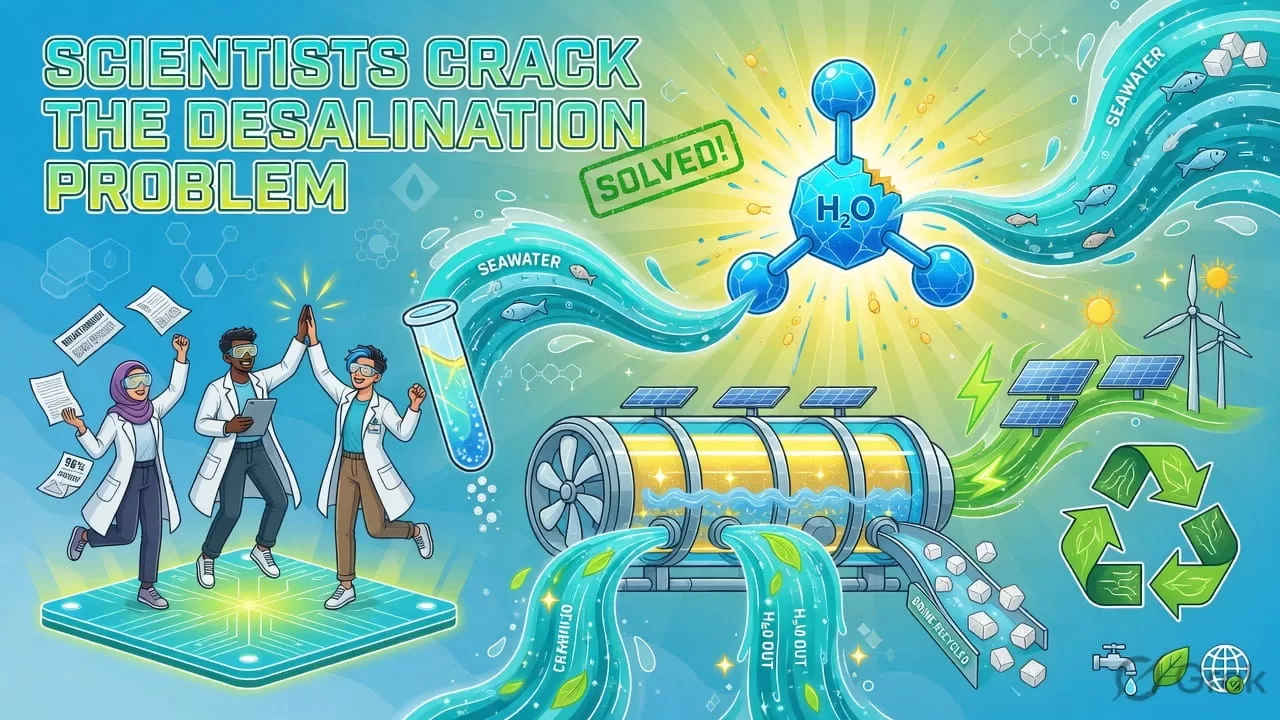
More than 2 billion people lack safe drinking water. A team in New York may have just found a key piece of the solution.
The Problem With How We Desalinate Water Today
Desalination — the process of removing salt from seawater to produce fresh drinking water — is not a new idea. Hundreds of large-scale desalination plants operate around the world, from the Gulf states to Israel to Australia. But conventional desalination comes with a serious environmental cost that is rarely discussed.
Most current methods, including reverse osmosis and multi-stage flash distillation, are highly energy-intensive. More critically, they produce concentrated brine — a toxic, super-salty byproduct that is typically pumped back into the ocean. This brine kills marine life, disrupts coastal ecosystems, and creates dead zones around desalination outflows. It is, essentially, solving one environmental problem by creating another.
A breakthrough published on May 30, 2026, may have just changed that equation entirely.
The Rochester Breakthrough
Researchers at the University of Rochester’s Institute of Optics, led by Professor Chunlei Guo, have developed a solar-thermal desalination process that converts seawater to drinking water with zero brine discharge and requires no chemical additives to pre-treat the water.
The study, published in the journal Light: Science & Applications, describes a device built around a specially engineered material called superwicking black metal (SWBM) — a metal surface precision-textured using femtosecond laser pulses at microscopic scales.
How It Works: The Science Behind the Metal Panels
The laser-etching process gives the metal surface two extraordinary properties working in combination:
1. Near-total solar absorption: The textured surface absorbs almost all incoming sunlight, converting it directly into heat with remarkable efficiency — no fuel, no electricity required.
2. Superwicking: The surface draws seawater across itself in a thin, continuous film through capillary action. As this film of seawater spreads across the heated surface, solar energy drives evaporation — separating pure water vapour (which is collected as drinking water) from the dissolved salts and minerals.
The real innovation is what happens to those salts. Rather than concentrating them into liquid brine, the system’s precisely engineered grooves cause the crystalised salts to automatically migrate away from the active evaporation zone — a self-cleaning mechanism that prevents the surface from clogging while collecting solid salt deposits that can be removed and used.
The Lithium Bonus
The researchers did not stop there. In related work, they modified the same laser-textured surface by embedding hydrogen titanate nanoparticles into its grooves. These particles selectively capture lithium ions from the seawater, enabling the system to separate and extract lithium from the other dissolved salts.
This is significant because lithium is a critical material for rechargeable batteries — the backbone of electric vehicles and grid-scale energy storage. Mining lithium from the ocean, rather than from ecologically damaging terrestrial mines, could transform both water security and battery supply chains simultaneously.
The system was successfully tested with water from three different oceans and demonstrated recovery of nearly all salts as usable solid materials.
What This Means for Water Security
The numbers are stark. According to the United Nations, 2.2 billion people still do not have access to safely managed drinking water. Climate change is intensifying this crisis by reducing rainfall in already water-stressed regions, accelerating glacier melt that feeds major rivers, and raising temperatures that increase evaporation from reservoirs and lakes.
Coastal regions — where two-thirds of the world’s population will live by 2050 — sit adjacent to an almost limitless supply of seawater. A solar-powered desalination system that requires no fuel, no chemicals, and produces no toxic waste is potentially transformational for these communities.
For India in particular, which faces acute water stress across its peninsular and arid regions, technologies like this represent a pathway to water independence that does not depend on monsoon reliability.
The Road From Lab to Scale
The honest caveat: this technology has been demonstrated at laboratory scale. The journey from a University of Rochester research device to a plant capable of supplying water to a city involves engineering challenges, cost reduction, and real-world deployment testing that could take years.
But the fundamental physics works, the chemistry works, and the self-cleaning mechanism solves the key practical problem that has plagued previous solar desalination attempts. This is not a theoretical concept — it is a working device with tested results across multiple ocean water samples.
AI Summary
A research team at the University of Rochester has developed a solar-powered desalination device that produces clean drinking water from seawater without generating brine waste or requiring chemical additives. The system uses laser-textured superwicking black metal panels that absorb sunlight, evaporate seawater, and automatically collect crystallised salts — which can also be processed to extract lithium for batteries. Published in Light: Science & Applications in May 2026, the breakthrough addresses one of the biggest limitations of conventional desalination and could have major implications for global water security.
Leave a Reply