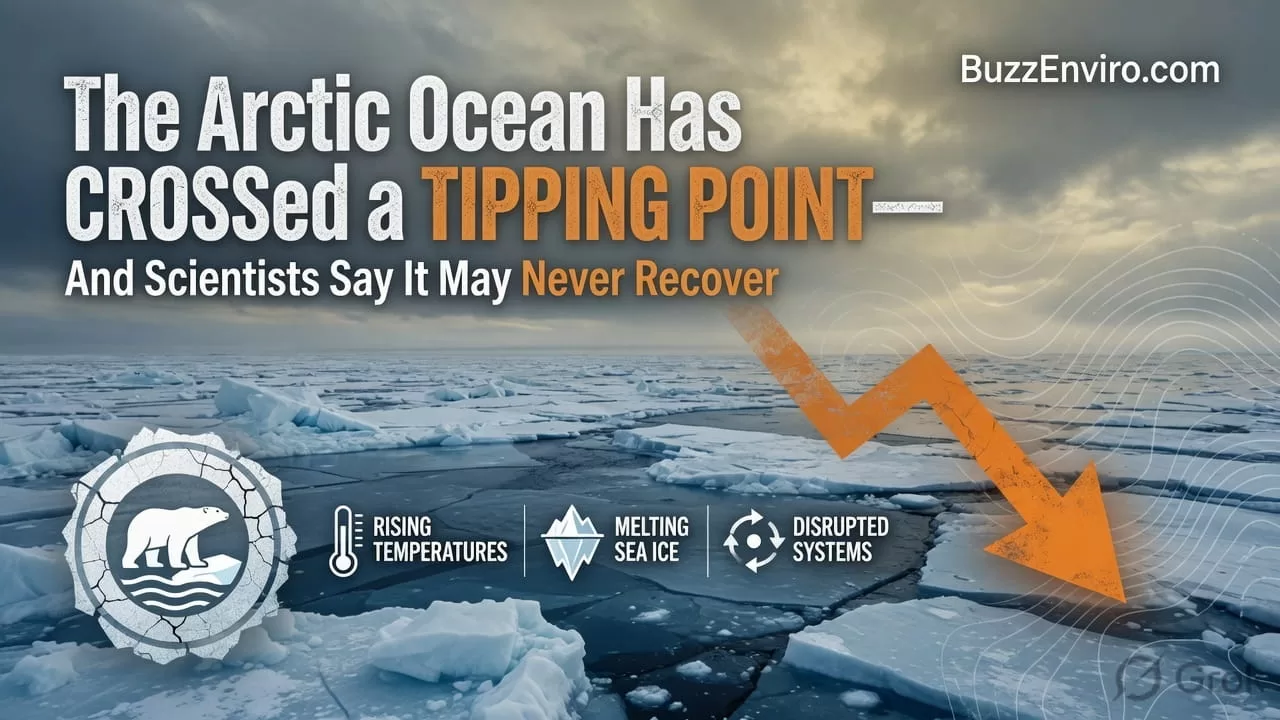
We expected melting Arctic ice to create more life. The opposite is happening — and the consequences reach far beyond the poles.
The Study That Changed Everything
A landmark study published in late May 2026 in the journal Communications Earth & Environment has delivered one of the most alarming findings in recent climate science. Researchers at the University of Edinburgh, led by Professor Raja Ganeshram and co-led by PhD student Marta Santos-García, have found that the Arctic Ocean crossed a dangerous chemical tipping point — and the data suggests it happened around 2009.
The research draws on more than 20 years of ocean sampling data from the Fram Strait — the main channel through which Arctic waters drain into the Atlantic Ocean. What they found defied a widely held scientific assumption.
What Scientists Expected vs. What Is Actually Happening
For years, the scientific community believed that melting Arctic sea ice would be a net positive for marine biology. The logic was simple: less ice means more sunlight reaching the surface water, which means more photosynthesis, which means more phytoplankton growth.
Santos-García’s findings overturn this assumption entirely. The Arctic Ocean appears to have shifted from a system mainly limited by light to one increasingly limited by nitrate availability — with far-reaching consequences for marine ecosystems, food chains, and the role of the Arctic in Earth’s climate.
The Hidden Chemical Mechanism
Here is what is actually happening beneath the surface:
When sea ice retreats, vast shallow regions of the Arctic Ocean — previously covered and protected by ice — are suddenly exposed to direct sunlight. This triggers a chemical process called benthic denitrification: sunlight hitting the shallow continental shelves drives a reaction that converts nitrate in the seawater into nitrogen gas, which simply escapes into the atmosphere.
Shallow continental shelves underlie nearly half of the Arctic Ocean, meaning this process is operating at an enormous scale. The Chukchi Sea and the East Siberian shelf are identified as the primary zones of nitrate removal, with researchers estimating these two shelf areas remove approximately 12 teragrams of nitrogen annually — offsetting a substantial portion of the nutrients entering the Arctic from the Pacific Ocean.
The result: nitrate levels in waters leaving the Arctic have been falling steadily since 2009, precisely coinciding with the period of most dramatic sea ice loss.
Why Nitrate Matters: The Food Chain Collapse
Nitrate sits at the base of the entire marine food web. It fuels the growth of phytoplankton — microscopic algae that are the starting point of almost every food chain in the ocean.
When nitrate drops, the ecosystem reorganises in a damaging way. Larger, nutrient-dense plankton species like diatoms — which efficiently transfer energy upward to zooplankton, fish, and larger marine predators — are replaced by smaller plankton species that can survive in nutrient-starved water. But these smaller species transfer far less energy up the food chain. The result is a systematic reduction in the food supply available to fish, seabirds, and marine mammals across the entire region.
This biological reorganisation is already occurring. Documented shifts in plankton populations have been observed across the Chukchi Sea and the Fram Strait.
The Carbon Storage Problem
The collapse of phytoplankton populations carries a second, compounding consequence: the Arctic Ocean’s ability to absorb carbon dioxide from the atmosphere is also diminishing.
Phytoplankton pull CO₂ out of the atmosphere during photosynthesis. When they die, some of that carbon sinks into the deep ocean or settles into seafloor sediment — a process called the marine biological pump. Fewer phytoplankton means less carbon captured, which means more CO₂ remains in the atmosphere, accelerating the very warming that is driving sea ice loss in the first place.
Is This Reversible?
This is the question that makes this study particularly alarming. The research team is unambiguous: the change is very unlikely to reverse because it is being driven by ongoing sea ice loss. There is no realistic scenario in which sea ice returns to pre-2009 levels within any policy-relevant timeframe.
Professor Ganeshram noted that how this change cascades through the food chain needs to be closely monitored, as it has profound implications, including on commercial fishing in the North Atlantic Ocean.
What This Means for the World
The Arctic might seem distant, but its food chains and carbon cycles are deeply connected to global systems:
- Commercial fishing in the North Atlantic — already under pressure from warming waters — faces a long-term collapse in its biological foundation
- Indigenous Arctic communities dependent on marine wildlife face an existential threat to their food security
- Global carbon budgets become harder to manage as the ocean’s capacity to absorb CO₂ decreases
- Climate projections that assumed stable Arctic productivity may need significant revision
AI Summary
University of Edinburgh researchers have confirmed that the Arctic Ocean crossed a chemical tipping point around 2009, triggered by accelerating sea ice loss. The loss of ice exposes shallow ocean shelves to sunlight, driving a process that destroys nitrate — the key nutrient sustaining all marine life. Published in Communications Earth & Environment, the study found this shift may already be irreversible and is reorganising the entire Arctic food chain from the bottom up, with consequences for fisheries, wildlife, and global carbon storage.
Leave a Reply