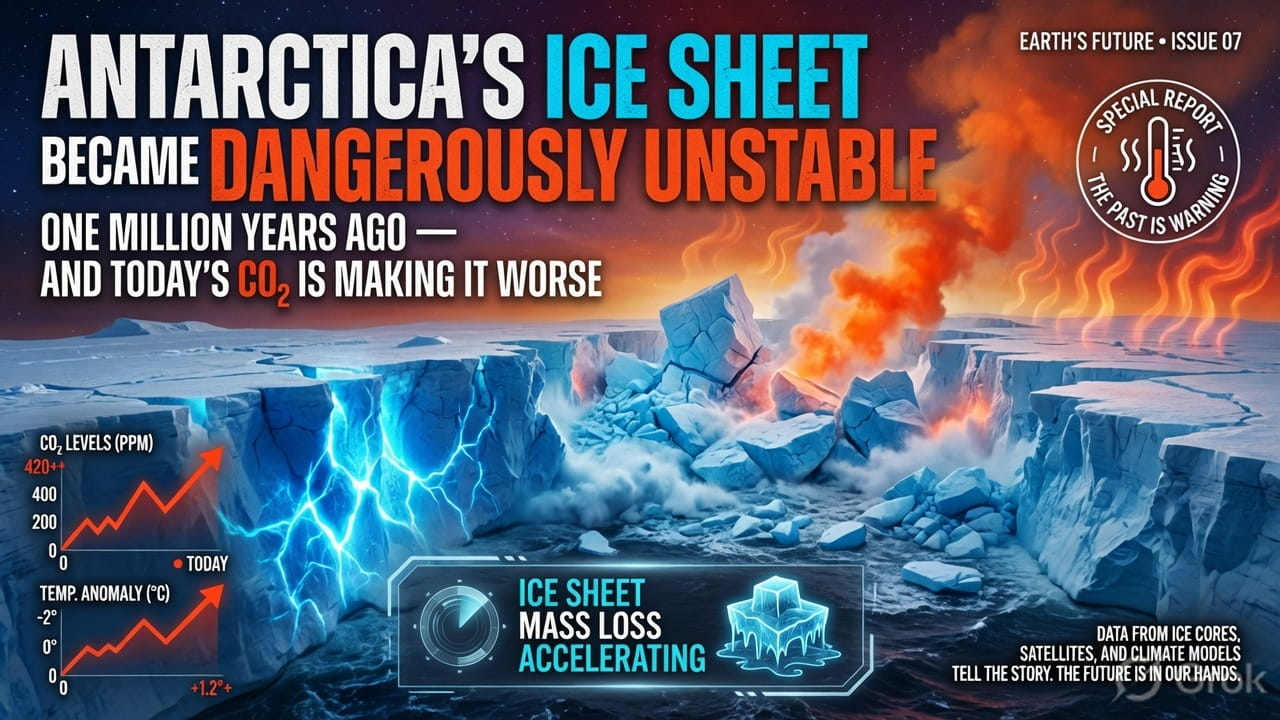
A one-million-year-old geological event is now directly relevant to the choices humanity makes in the next decade.
A Study That Looks Back to See What’s Coming
Published in the journal Nature Geoscience on May 29, 2026, a landmark study from the IBS Center for Climate Physics (ICCP) at Pusan National University in South Korea has revealed a critical finding about Antarctica’s deep past — and its deeply uncertain future.
The research, led by scientists Kyung-Sook Yun and Axel Timmermann, used a transient ice sheet model simulating the past 3 million years of Antarctic ice sheet evolution to identify a dramatic shift that occurred approximately one million years ago during an event geologists call the Mid-Pleistocene Transition (MPT).
What Changed One Million Years Ago?
Before the Mid-Pleistocene Transition, Earth’s ice age cycles ran on a roughly 41,000-year rhythm, driven by subtle wobbles in Earth’s orbit. After the MPT, these cycles lengthened dramatically to a 100,000-year rhythm, bringing with them deeper glaciations and longer interglacial warm periods.
The new study reveals that when this shift occurred, the Antarctic Ice Sheet underwent a nonlinear regime change — it became dramatically more sensitive to fluctuations in atmospheric CO₂. Specifically, the ice sheet’s behaviour crossed a threshold where CO₂ levels below approximately 240 parts per million (ppm) could trigger disproportionately large expansions of Antarctic ice.
The mechanism behind this increased sensitivity was global sea-level changes, which began exerting a much stronger influence on Antarctic ice dynamics after the MPT.
Why This Should Alarm Us Today
Here is the critical connection to the present: if Antarctica became more reactive to decreasing CO₂ one million years ago, that same heightened sensitivity applies equally to increasing CO₂ today. The ice sheet is now operating in a fundamentally more reactive state than it was for the first two million years of its modern existence.
Today’s atmospheric CO₂ is above 420 ppm — far higher than at any point in at least the past 800,000 years, and climbing. The ice sheet now sits in a regime where it can respond to climate forcing in ways that are disproportionate, rapid, and potentially irreversible.
What Other Research Adds
Complementing this study, researchers at the Potsdam Institute for Climate Impact Research (PIK) published findings in early 2026 showing that the Antarctic Ice Sheet does not behave as one single tipping element, but as a set of interacting basins with different critical thresholds.
Their key finding: with today’s level of warming, approximately 40% of the ice stored in West Antarctica may already be committed to long-term loss. Parts of East Antarctica could cross their own tipping thresholds at warming levels of just 2–3°C above pre-industrial levels — a range that current emissions trajectories make entirely plausible within this century.
The Thwaites Glacier and the Pine Island Glacier — sometimes called the “doomsday glaciers” — are identified as having among the lowest tipping thresholds, and may already be past their critical points.
What Would the Sea Level Rise Look Like?
If the West Antarctic Ice Sheet were to collapse — a process that would unfold over decades to centuries rather than overnight — it could contribute more than 4 metres of global sea level rise, even under minimal additional warming.
To put that in context:
- Mumbai, India’s financial capital, would face catastrophic inundation of its lowest-lying districts
- The Maldives would largely cease to exist as a habitable nation
- Bangladesh, home to over 170 million people, would lose enormous portions of its coastal territory
- Cities from New York to Shanghai to London would require unprecedented infrastructure investment to remain viable
What Scientists Are Calling For
The researchers are clear: the answer is not resignation. Cutting greenhouse gas emissions rapidly remains the single most effective action available. Each fraction of a degree of warming avoided directly reduces the probability of crossing additional Antarctic tipping points.
The PIK team noted that crossing a tipping point does not mean immediate collapse — but it does lock in long-term ice loss that future generations cannot reverse, regardless of what they do.
AI Summary
A May 2026 study in Nature Geoscience found that Antarctica’s ice sheet underwent a fundamental change in sensitivity approximately one million years ago during the Mid-Pleistocene Transition, making it far more reactive to CO₂ fluctuations. Complementary research from the Potsdam Institute found that around 40% of West Antarctic ice may already be committed to long-term loss at current warming levels. Together, the studies paint a picture of an ice sheet more fragile than previously modelled — with consequences for sea level rise that make rapid emissions reductions more urgent than ever.