
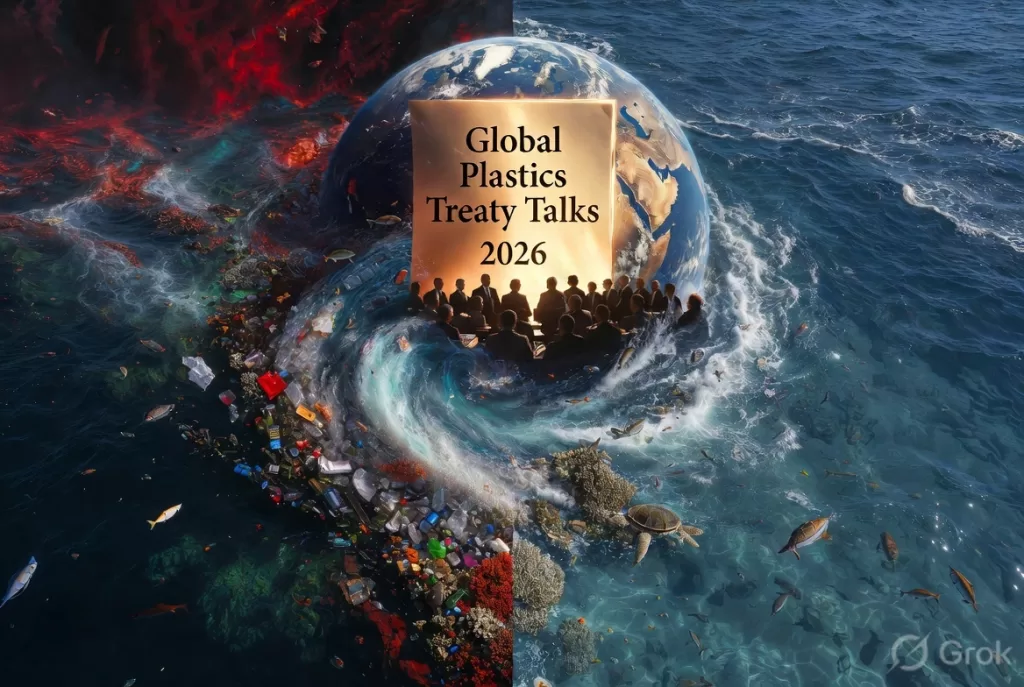
After months of deadlock, international negotiations toward a legally binding Global Plastics Treaty have received fresh impetus. In February 2026, countries elected Chile’s Ambassador Julio Cordano as the new Chair of the Intergovernmental Negotiating Committee (INC), followed by a detailed roadmap in March to restart substantive talks.
Background of the Crisis Plastic production has exploded since the 1950s, with billions of tonnes now polluting every corner of the planet — from deep ocean trenches to human bloodstreams. Microplastics contaminate food, water, and air, while marine ecosystems suffer from entanglement and ingestion.
The treaty aims for a full life-cycle approach: addressing production, design, consumption, and waste management — not just end-of-pipe recycling.
Recent Developments
- INC-5.3 (February 2026): A one-day session in Geneva focused on leadership transition after the previous chair’s resignation in 2025. No substantive talks occurred, but Cordano’s election was seen as a positive procedural breakthrough.
- March 2026 Roadmap: Informal meetings, regional consultations, and working groups are planned throughout 2026 to bridge deep divisions. The next formal round (INC-5.4) is targeted for late 2026 or early 2027.
Key Points of Contention
- Production Caps vs. Waste Management: Many nations (especially low- and middle-income countries) push for limits on virgin plastic production. Others, including some major producers, prefer focusing on recycling targets and downstream solutions.
- Ambition Level: Disagreements remain on legally binding targets, financial support for developing nations, and elimination of problematic single-use plastics.
- Just Transition: Ensuring the treaty supports workers in plastic-dependent industries while promoting circular economy jobs.
Why 2026 Is Make-or-Break Momentum is building despite past stalls (notably in Busan 2024 and Geneva 2025). The new Chair brings diplomatic experience, and informal sessions aim to build consensus before formal negotiations resume. Observers note that success depends on compromise between high-ambition and industry-friendly blocs.
Global Stakes A strong treaty could cut plastic pollution by 80% or more by 2040, according to UNEP models. It would also reduce greenhouse gas emissions (plastics are fossil-fuel derived) and protect biodiversity. Failure, however, risks locking in decades more of unchecked pollution.
Positive Signals Several countries are already advancing national policies — banning single-use items, introducing extended producer responsibility, and investing in alternatives. Corporate giants are facing growing pressure from consumers and investors.
Path Forward Success requires bridging divides on finance, technology transfer, and enforcement. The roadmap offers a “predictable pathway,” but political will at the highest levels will determine the outcome.
The world cannot afford another year of delay. With plastic pollution worsening daily, 2026–2027 represents a critical window for global action.