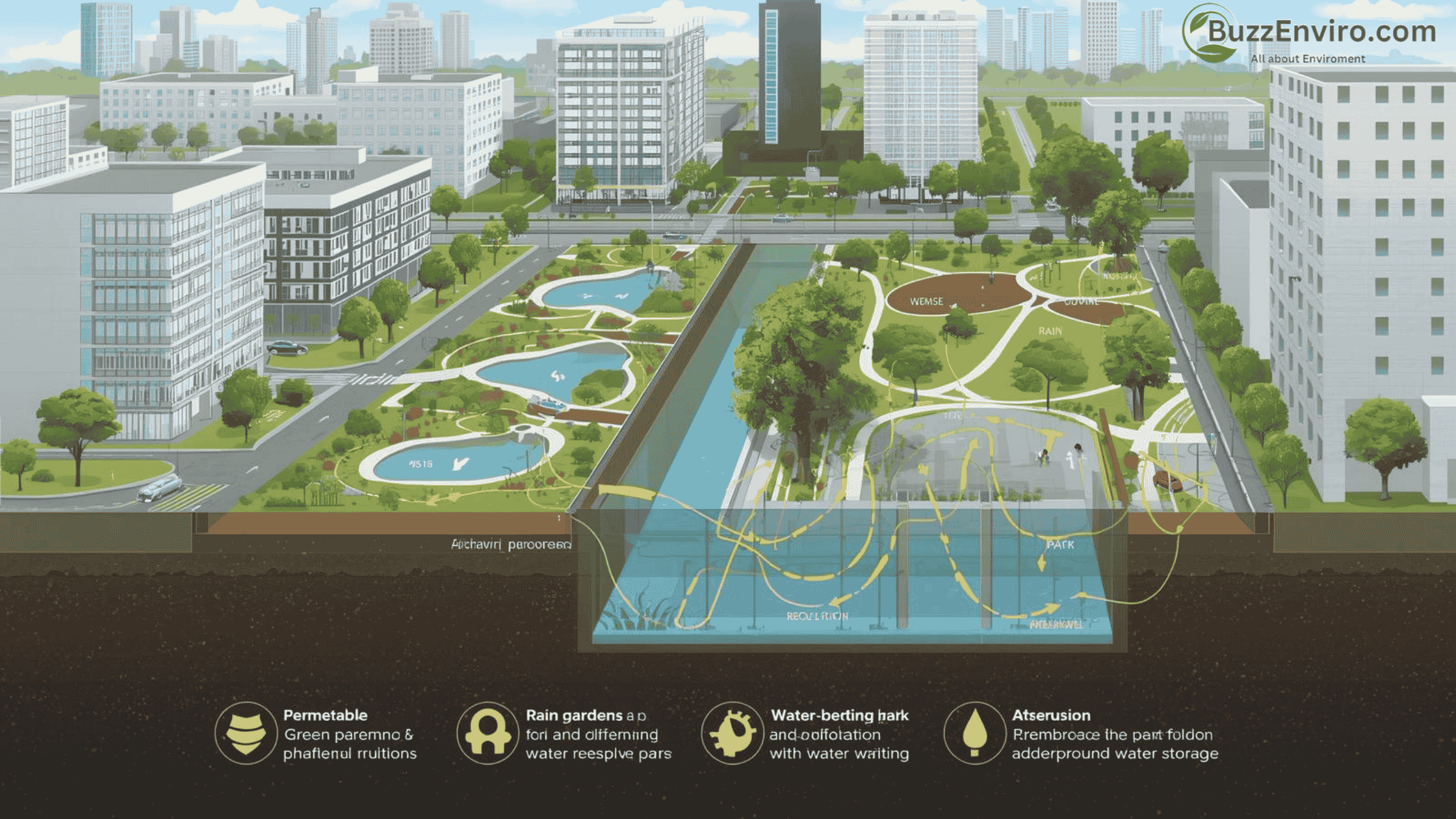
Urban flooding is no longer an occasional disruption—it is becoming a recurring crisis. Cities across the world are experiencing flash floods that overwhelm drainage systems, damage infrastructure, displace communities, and expose deep flaws in how urban areas are designed. The problem is not just heavier rainfall. It is how cities handle water.
In response, a growing number of planners, governments, and researchers are turning to an approach known as the sponge city. Rather than forcing rainwater away through concrete channels and pipes, sponge cities are designed to absorb, store, filter, and slowly release water, reducing flood risk while improving urban resilience.
This article explores what sponge cities are, why traditional flood protection is failing, and real sponge city examples that show how urban design can reduce flooding as climate risks intensify toward 2026 and beyond.
📑 Table of Contents
- 1. Introduction: Why Urban Flooding Is a Design Problem
- 2. What Is a Sponge City?
- 3. Why Traditional Drainage Systems Are Failing
- 4. How Sponge City Design Reduces Flood Risk
- 5. Real Sponge City Examples From Around the World
- 6. China’s Sponge City Program
- 7. Copenhagen’s Climate-Resilient Streets
- 8. Rotterdam’s Water Squares
- 9. Singapore’s Water-Sensitive Urban Design
- 10. Portland’s Green Streets
- 11. Sponge Cities vs Conventional Flood Control
- 12. Why Sponge Cities Matter for 2026 and Beyond
- 13. Challenges and Limitations of Sponge City Design
- 14. Can Sponge Cities Work in Developing Countries?
- 15. Biodiversity and Climate Benefits of Sponge Cities
- 16. Conclusion: Designing Cities That Absorb, Not Collapse
Why Urban Flood Protection Is Failing?
Most modern cities were built with a simple goal: move water away as fast as possible. Roads, rooftops, pavements, and parking areas are designed to repel water, pushing it into underground drainage systems.
This model is now breaking down for three key reasons:
1. Climate Change Is Intensifying Rainfall
As global temperatures rise, the atmosphere holds more moisture. According to the Intergovernmental Panel on Climate Change (IPCC), extreme precipitation events are becoming more frequent and intense in many regions, increasing the likelihood of sudden urban floods.
2. Cities Are Covered in Impermeable Surfaces
Concrete and asphalt prevent rainwater from soaking into the ground. Instead, water flows rapidly across surfaces, overwhelming drains and causing surface flooding.
3. Natural Water Buffers Have Been Lost
Wetlands, floodplains, ponds, and open soils once absorbed excess rain. Urban expansion has replaced many of these natural buffers with built infrastructure.
Sponge cities aim to correct these design failures by restoring the natural water cycle within urban environments.
What Is a Sponge City?
A sponge city is an urban planning approach that allows cities to function like sponges—absorbing rainfall instead of repelling it.
Rather than relying only on pipes and drains, sponge cities use nature-based and water-sensitive design solutions, such as:
- Permeable pavements
- Green roofs
- Rain gardens and bioswales
- Urban wetlands and ponds
- Restored rivers and floodplains
The goal is to manage rainwater where it falls, reducing runoff and lowering flood peaks.
How Sponge Cities Redesign Flood Protection?
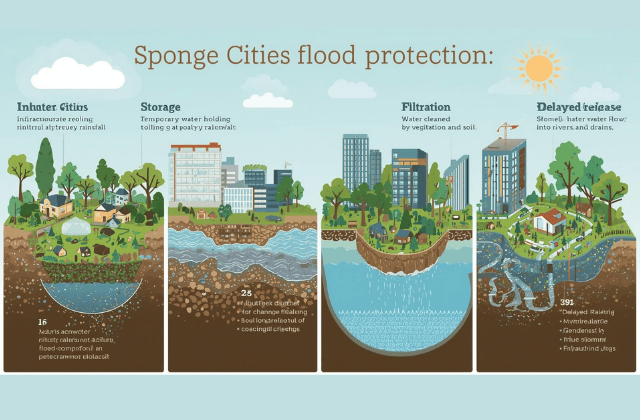
Sponge city design shifts flood protection from emergency response to prevention.
Key principles include:
- Infiltration – allowing water to soak into soil
- Storage – holding water temporarily during heavy rainfall
- Filtration – cleaning water through vegetation and soil
- Delayed release – slowing water flow into rivers and drains
By spreading water across landscapes rather than concentrating it in drains, sponge cities reduce pressure on urban infrastructure.
Real Sponge City Examples From Around the World
While the concept may sound theoretical, sponge city principles are already being applied in diverse urban contexts. These examples show how design changes can significantly reduce flood risk.
1. China’s Sponge City Program
China launched its national Sponge City Initiative in 2015 following a series of devastating urban floods that caused widespread economic damage.
Key measures include:
- Permeable roads and sidewalks
- Green roofs on public and residential buildings
- Expanded urban wetlands and lakes
- Rainwater harvesting systems
Cities such as Wuhan, Shenzhen, and Xiamen have integrated sponge infrastructure into new developments and retrofitted older neighborhoods. Studies have shown reduced surface runoff and improved stormwater management during heavy rainfall events.
China’s experience demonstrates that sponge cities can be implemented at large scale, not just as isolated pilot projects.
2. Copenhagen, Denmark: Climate-Resilient Streets
After severe flooding in 2011, Copenhagen redesigned parts of the city to safely manage excess water rather than fight it.
Key features include:
- Streets designed to channel floodwater away from buildings
- Parks and public spaces that temporarily store water
- Green areas integrated into flood management systems
These changes are part of Copenhagen’s broader climate adaptation strategy, which treats flooding as a design challenge rather than a failure.
3. Rotterdam, Netherlands: Water Squares
Rotterdam’s water squares are multifunctional public spaces designed for both daily use and extreme weather.
- During dry weather, they function as playgrounds and plazas
- During heavy rain, they collect and store excess water
This approach prevents flooding while maintaining social and recreational value, showing that sponge city design can enhance urban life rather than restrict it.
4. Singapore: A City Designed Around Water
Singapore has long integrated water-sensitive urban design into city planning.
Key elements include:
- Extensive green roofs and vertical greenery
- Rain gardens and bioswales
- Reservoirs that serve both flood control and recreation
Despite high annual rainfall, Singapore experiences relatively low flood damage, illustrating how sponge city principles can be embedded into dense urban environments.
5. Portland, USA: Green Streets Program
Portland’s Green Streets initiative uses:
- Vegetated curb extensions
- Permeable pavements
- Rain gardens along roads
These features reduce stormwater runoff, improve water quality, and lower the cost of expanding underground drainage systems.
Sponge Cities vs Traditional Flood Control
| Traditional Flood Control | Sponge City Design |
| Pipes and drains | Nature-based solutions |
| Rapid runoff | Slow absorption |
| Single-purpose infrastructure | Multi-functional public spaces |
| High maintenance costs | Long-term resilience |
| Reactive flood response | Preventive design |
Sponge cities focus on system resilience, not just damage control.
Why Sponge Cities Matter for 2026 Climate Resilience Planning?
As cities plan for 2026 and beyond, sponge city design is increasingly seen as essential.
Sponge cities:
- Reduce flood risk under extreme rainfall
- Improve urban water quality
- Lower heat island effects
- Support urban biodiversity
- Increase community resilience
With climate uncertainty rising, flexible and adaptive infrastructure is more valuable than rigid systems designed for past conditions.
Challenges and Limitations of Sponge City Design
Sponge cities are not a universal solution and face real challenges:
- High upfront investment costs
- Limited space in dense urban areas
- Need for long-term maintenance
- Risk of superficial “green” projects without systemic impact
Poorly implemented sponge infrastructure can become greenwashing, offering aesthetic improvements without meaningful flood protection.
Can Sponge Cities Work in Developing Countries?
Yes—but only if adapted to local contexts.
In rapidly urbanizing regions, sponge city principles can include:
- Protecting existing wetlands and lakes
- Promoting rainwater harvesting
- Using permeable materials in footpaths and parking areas
- Community-managed green spaces
Rather than copying models from Europe or China, cities must design solutions that reflect local climate, governance, and social realities.
Sponge Cities and Urban Biodiversity
Beyond flood protection, sponge cities restore ecological functions within cities.
Benefits include:
- Habitat for birds and pollinators
- Healthier soils and vegetation
- Improved groundwater recharge
- More resilient urban ecosystems
By restoring water cycles, sponge cities also support biodiversity in environments where nature has been heavily fragmented.
Conclusion: Designing Cities That Absorb, Not Collapse
Urban floods are often framed as natural disasters, but in many cases they are design failures.
Sponge city examples from around the world show that cities can reduce flood risk by rethinking their relationship with water. Instead of pushing rain away as fast as possible, sponge cities absorb it, manage it, and learn from natural systems.
As climate risks intensify toward 2026, the question is no longer whether sponge city design is innovative—it is whether cities can afford to continue building in ways that fail repeatedly.
Cities that learn to absorb water today will be the ones that remain livable tomorrow.
Also Read:- Top 10 Extinct Plants and the Reason for their Extinction
❓ Frequently Asked Questions
1. What is a sponge city?
A sponge city is an urban design approach that uses natural and engineered systems like green roofs, wetlands, and permeable pavements to absorb rainwater and reduce flood risk.
2. How do sponge cities help prevent urban flooding?
Sponge cities slow down and store rainwater using green infrastructure, reducing pressure on drainage systems and lowering the chances of flash floods during extreme rainfall.
3. Which countries are leading sponge city development?
China, the Netherlands, Singapore, Denmark, and the United States are leading sponge city initiatives through climate-resilient infrastructure and sustainable water management projects.
4. Are sponge cities expensive to build?
Initial costs can be high, but sponge city infrastructure often reduces long-term flood damage, lowers maintenance costs, and improves urban biodiversity and water quality.
5. Can sponge city concepts work in developing countries?
Yes. Many sponge city solutions like rain gardens, urban wetlands, and permeable streets can be adapted to developing countries with cost-effective and community-driven designs.