
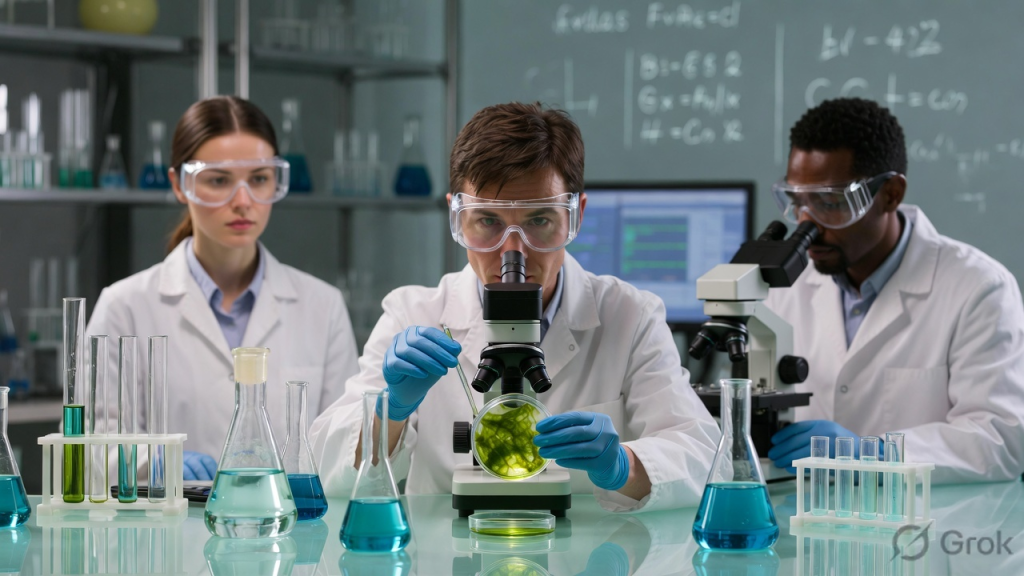
Microplastics are everywhere — in oceans, rivers, rainwater, food, and even the human bloodstream. One of the most troubling problems is that conventional wastewater treatment plants simply cannot catch them. The particles are too small, too numerous, and too chemically resistant. But a 2026 breakthrough from the University of Missouri offers a remarkable natural solution: a genetically engineered strain of algae that binds to microplastics and clumps them into easy-to-remove masses.
The Scale of the Microplastics Problem
More than 460 million metric tons of plastic are produced globally every year. A significant fraction ends up in waterways — as plastic debris that slowly fragments into microplastics (particles under 5mm) and nanoplastics (particles under 1 micron). Scientists have detected microplastics in every major ocean, in Arctic ice, in the deepest ocean trenches, and — increasingly — inside the human body.
Studies have found microplastics in human blood, lung tissue, placentas, and breast milk. Research published in recent years links chronic microplastic exposure to inflammation, hormonal disruption, and potential carcinogenic effects. The World Health Organization has flagged microplastics in drinking water as an emerging public health concern, though the full extent of health impacts is still being studied.
The core challenge for water treatment is physical: microplastics are hydrophobic — they repel water — making them difficult to aggregate and filter out using conventional methods. Most wastewater plants can only remove larger plastic fragments, allowing the smallest and most dangerous particles to pass straight through into drinking water sources.
How the Algae Solution Works
Researcher Susie Dai, a professor in the College of Engineering and principal investigator at the Bond Life Sciences Center at the University of Missouri, developed a revolutionary approach. Her team used genetic engineering to create a modified strain of algae that produces limonene — the natural volatile oil responsible for the fresh scent of oranges.
Limonene makes the algae’s surface water-repellent. Since microplastics are also water-repellent, the two materials are chemically attracted to each other. The microplastics bind to the algae surface, forming larger clumps that are heavy enough to sink — and far easier to filter out of water during treatment. The research, published in Nature Communicationsin 2026, demonstrates both the effectiveness of the technique and its potential for scale-up.
Critically, the algae also continue to clean wastewater as they grow — filtering out other pollutants while simultaneously capturing plastic particles. Dai’s lab is already growing the algae in large tank bioreactors, with plans to scale them up for integration into existing wastewater treatment infrastructure.
A Three-in-One Environmental Solution
What makes this innovation particularly compelling is its circular potential. Dai’s long-term goal is not just to remove microplastics — it is to use the collected plastic. The captured microplastics can be repurposed and transformed into safer bioplastic materials, including composite plastic films.
As Dai explained: “By removing the microplastics, cleaning the wastewater, and eventually using the removed microplastics to create bioplastic products, we can tackle three issues with one approach.” This vision aligns directly with circular economy principles — reducing waste while creating new value streams.
Current Limitations and the Road Ahead
The research is still in early stages. The algae-based system has been tested primarily in laboratory bioreactor conditions, and scaling it to the volume of water processed by large urban treatment facilities will require significant engineering development. Ensuring the engineered algae do not escape into natural waterways and outcompete native species is also a critical biosafety consideration researchers are actively studying.
Despite these hurdles, scientists and environmental engineers see algae-based filtration as one of the most promising near-term approaches to the microplastics crisis. Unlike expensive industrial filtration upgrades, algae-based systems are inherently scalable, biodegradable, and potentially self-sustaining.
What This Means for the Future of Clean Water
This discovery matters not only for what it removes from water, but for what it represents: nature-inspired engineering that works with biology rather than against it. As microplastic contamination deepens in water systems worldwide, solutions that can be integrated into existing infrastructure at scale are desperately needed.
The algae breakthrough brings that future significantly closer. Further investment, regulatory support, and accelerated testing will determine how quickly cities worldwide can deploy this technology to make drinking water genuinely microplastic-free.
Key Takeaways
University of Missouri researchers have engineered algae that uses limonene oil to bind and aggregate microplastics, enabling their removal from water. Published in Nature Communications, the breakthrough tackles microplastics in drinking water, wastewater treatment, and plastic recycling in a single circular system. It represents one of the most promising pollution solutions of 2026.