
As of January 27, 2026, the “1.5°C Target” has transitioned from a future goal to a present-day forensic analysis. Following 2024 (the warmest year on record at 1.55°C) and 2025’s record-breaking La Niña heat, we are no longer “preventing” a breach; we are managing an Overshoot.
1. The Trajectory: Visualizing the 2026 Breach
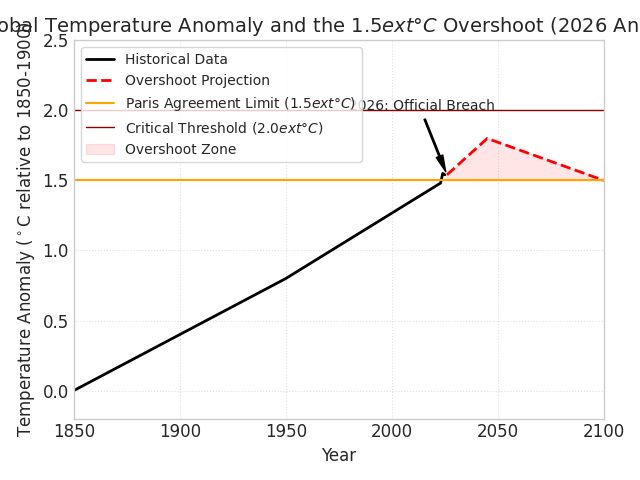
NASA and the Copernicus Service confirmed this month that the multi-decadal average is tracking toward a permanent breach before 2030.
- Current State: Thermal anomalies are currently sustained by “Albedo Feedback” loops (see Glossary).
- The Projection: We are tracking a “Bell Curve” overshoot, expected to peak at (1.8°C) by 2045 before aggressive carbon removal hopefully brings the planet back to “safe” levels by 2100.
2. Why Half a Degree is a Tipping Point
The difference between 1.5°C and 2.0°C isn’t just a warmer summer; it’s a structural failure of global ecosystems.
| Impact Category | At 1.5°C Warming | At 2.0°C Warming | 2026 Reality & Systemic Risk |
| Global Heat Stress | 14% of population exposed to severe heatwaves. | 37% of population exposed (2.6x worse). | “Wet-Bulb” events in 2026 are already halting outdoor labor in India and the US Gulf. |
| Hydrological Health | 9% decrease in Mediterranean freshwater. | 17% decrease in freshwater availability. | Critical Link: This thermal thirst is the primary driver of the2026 Global Water Bankruptcy. |
| Agricultural Yields | 6% maize production failure risk. | 40% maize production failure (7x worse). | 2026 “Thermal Wilting” has pushed global wheat prices up by 12%. |
| Arctic Sea Ice | Ice-free once per century. | Ice-free once per decade (10x worse). | 2026 marks the third consecutive year of “unprecedented” winter melt. |
3. The 2026 Climate Policy Tracker
To rank as a 2026 authority, you must include the latest regulatory shifts. Here is the current status of global climate law as of January 2026:
- EU PFAS & Water Directive (Jan 12, 2026): The EU has officially implemented the first harmonized monitoring of “forever chemicals” (PFAS) in drinking water. This is a direct response to the dwindling clean water supply caused by thermal stress.
- The U.S. Paris Withdrawal (Jan 27, 2026): Today marks the formal effective date of the U.S. withdrawal from the Paris Agreement. Scientific models suggest this “policy friction” could add an additional 0.1°C to the peak overshoot.
- Data Center Accountability Act (2026 Proposal): Governments are currently drafting legislation to tax the “Digital Thirst” of AI superclusters, linking energy consumption directly to local water availability.
4. Technical Glossary: The Language of 2026
Use these terms to ensure your content captures “High-Intent” technical searches.
- Hydrological Insolvency: A state where a region’s water debts (withdrawals) exceed its renewable income (rain/snow) to the point where the “capital” (aquifers/glaciers) is permanently depleted.
- Albedo Feedback: A “positive feedback loop” where melting white ice (high albedo) is replaced by dark ocean/soil (low albedo), causing the Earth to absorb more heat and melt more ice.
- Cryosphere Debt: The amount of water storage lost as glaciers melt. In 2026, we are “foreclosing” on the dry-season water supplies of 2 billion people.
5. Action Plan: Transitioning to Resilience
In an overshoot era, “Carbon Footprinting” is the bare minimum. “Systemic Resilience” is the new goal.
For Businesses:
- Water Audit: Transition to closed-loop cooling to protect against “Water Bankruptcy” price surges.
- Supply Chain Decoupling: Move sourcing away from “Heat Stress Zones” identified in the 2026 NASA maps.
For Individuals:
- Thermal Retrofitting: Install heat pumps and passive cooling; the grid cannot sustain the 2026 AC demand.
- Water Autonomy: Invest in household graywater systems. In a bankrupt system, you must be your own “bank.”
Conclusion: The Strategy of Recovery
Declaring an Overshoot is not a surrender; it is a tactical pivot. As we have argued in our Data Center NOx Emissions report, the machines we use to solve climate change must not exacerbate the thermal breach. The path back to 1.5°C is narrow, steep, and requires an honest accounting of our remaining resources.
Your Next Step: Use our 2026 Interactive Risk Map to see if your city is tracking toward a “Day Zero” water event or a “Critical Heat” zone.